
'The (Maoist) organisation is in visible decline. Their senior leaders are ageing. Forest life is unforgiving -- older leaders simply cannot cope physically.' 'Earlier, they attracted educated youth from cities. That stream has dried up. Today's recruits largely come from poor village backgrounds and lack ideological depth.'

'Handling or mitigating a rebellion is not a corporate plan with quarterly, half-yearly and annual goals and results but an aggregation of the effort of several years.'

As the March 31 deadline arrives, a wave of Maoist surrenders suggests insurgency's end, but political and social concerns remain.

A CRPF jawan was injured in an IED blast during an anti-Maoist operation in Jharkhand's West Singhbhum district. The IED was planted by CPI (Maoists) in the Saranda forest.

A senior Maoist commander, Papa Rao, surrendered with his team in Chhattisgarh, signalling a significant blow to Left-Wing Extremism in the region. This event underscores the impact of sustained security pressure and rehabilitation efforts on the Maoist movement.

Security forces in Odisha's Kandhamal district seized a significant cache of arms and ammunition from a Maoist dump. The operation was launched based on information obtained from surrendered Maoists, leading to the recovery of a self-loading rifle, guns, detonators, and a grenade. This follows a similar seizure along the Odisha-Andhra Pradesh border recently.

After more than four decades, Chhattisgarh's Bastar region has been declared free of Left-Wing Extremism (LWE), marking the end of the armed Maoist rebellion in the area. The decline is attributed to sustained security operations, improved governance, and socio-economic development initiatives.
Twenty-seven Maoists surrendered to police in Ranchi, Jharkhand, as part of 'Operation Navjeevan'. The rebels laid down their arms before senior officers, with authorities appealing to others to return to the mainstream.

Odisha Chief Minister Mohan Charan Majhi announced significant progress in combating Maoist insurgency, stating it will soon be a thing of the past. He also addressed concerns about crimes against women, highlighting the government's commitment to justice and a zero-tolerance policy.
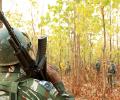
Security forces in Chhattisgarh's Bijapur district have recovered a significant amount of cash, arms, ammunition, and explosives from Maoist hideouts in the forests during search operations.

A woman Maoist leader carrying a bounty of Rs 15 lakh was arrested in Kolkata, while another red rebel surrendered before the police, a senior officer said.
It is a blatantly illegal and no holds barred war against the Indian State, against the idea and existence of the Indian democracy and must be dealt with an iron hand.
A woman Naxalite was killed in an encounter with security personnel in Chhattisgarh's Kanker district during an anti-Naxalite operation.

Police and security forces in Gadchiroli, Maharashtra, demolished 44 memorials built by Maoists to instill fear, marking a significant step in combating Naxalite influence in the region.

A combination of security pressure and rehabilitation efforts has significantly weakened Naxalism in India, leading to numerous surrenders and the elimination of key leaders.

Telangana Police's Special Intelligence Branch, led by officer B Sumathi, successfully negotiated the surrender of top Maoist commander Thippiri Tirupati alias Devuji and other Maoist leaders, marking a significant victory for the state.

'For the remaining Maoist cadres, they shall soon confront one of two outcomes: Either surrender or face neutralisation.'

Trinamool Congress leader Abhishek Banerjee has described Narendra Modi as the 'biggest brand ambassador' of the incumbent government in West Bengal, citing the prime minister's recent visit to Jhargram as proof of the TMC's success in restoring peace to the region.

Jharkhand Police have arrested Amrit Horo, the 'chief commander' of the banned People's Liberation Front of India (PLFI), a splinter group of the Maoists. Horo, who carried a bounty of Rs 10 lakh, was apprehended in a raid in the Mahugaon forest area.

The Indian government has deployed two battalions of the CRPF's CoBRA unit to Manipur to help restore peace in the region, which has been affected by ethnic violence.

'The watershed moment was June 22, 2024, when the divisional in-charge of Gadchiroli, Giridhar Tumreti, who was their senior-most commander, along with his wife, came forward to surrender before the then deputy chief minister and home minister Devendra Fadnavis.'

President Droupadi Murmu stated that government actions against Maoists have improved the atmosphere in Bastar, Chhattisgarh, leading to development. She encouraged those who have left violence to trust the Constitution.
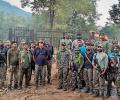
The government informed Lok Sabha that security forces have neutralised 29 top Naxal leaders since 2019, with a significant reduction in affected districts.

'They are not abandoning their ideology. They now believe it is better to pursue their goals through the Constitution rather than from the barrel of a gun -- even if the ideology itself remains intact.'

'The biggest game changer has been the belief among Maoists that they can surrender and join the mainstream'

'The Maoist leadership spread fear that surrender meant torture or death. Once that false narrative collapsed and our operations proved transparent and credible, the surrender momentum became irreversible.' 'From 42,000 square kilometres, Maoist activity is now confined to barely 500-600 square kilometres -- less than two per cent of Bastar. This is their last remaining base area.'
After recent high-intensity operations in the Bastar region and the neutralisation of several senior Maoist leaders, officials say the insurgency has lost its ability to mount large-scale coordinated attacks.

'From every point of view, they have faced an extremely difficult couple of years, and the setback they have suffered is irreversible.' 'This reality has begun to set in even amongst the top-level cadres. That is why, in recent times, we have witnessed a huge number of senior-level cadres emerging from the jungle and deciding to renounce violence and join the mainstream.'

Top Naxalite commander Madvi Hidma, who had masterminded several attacks over the last two decades, was killed in an encounter in neighbouring Andhra Pradesh on Tuesday, a breakthrough Chhattisgarh Police described as the 'last nail in the coffin' of the insurgency.

Seven more Maoists were killed in an exchange of fire with police in Andhra Pradesh, a day after six Maoists were gunned down in the same area. The operation took place in Maredumilli, Alluri Sitaramaraju district. One of the deceased was identified as Meturi Jokha Rao alias Tech Shankar, a key figure in the Maoist movement.
Chhattisgarh Deputy Chief Minister Vijay Sharma met surrendered Naxalites at a rehabilitation center in Sukma, offering them a visit to the state assembly and directing officials to improve their living conditions and opportunities.

Inspector general of police, Bastar Range, Sundarraj P said that bodies of seven Maoist cadres have been recovered from the encounter site so far.

The Bastar region of Chhattisgarh, India, is transitioning away from decades of Maoist conflict, with plans to convert security camps into public infrastructure. A senior Maoist commander recently surrendered, marking a significant step in the government's efforts to eliminate Naxalism.

Chhattisgarh Deputy Chief Minister Vijay Sharma announces the complete elimination of armed Naxals in the state, attributing the success to strategic planning and security operations. He highlights the rehabilitation efforts for remaining cadres and future plans for security camps.
Security forces have established a new camp in the Karregutta Hills along the Chhattisgarh-Telangana border, a former Naxal stronghold, following a major anti-Naxal operation.

Former Maoist insurgents have revealed a shocking practice within the CPI (Maoist) organization, where cadres are forced to undergo vasectomy before they are allowed to marry. This policy, designed to prevent distractions and ensure loyalty to the movement, has been implemented across the organization. The practice has been highlighted by several former insurgents who have now surrendered to the authorities.

West Bengal Chief Minister Mamata Banerjee has accused President Droupadi Murmu of acting on the advice of the BJP and questioned her silence on issues affecting tribal communities in other states. This comes after Murmu raised concerns about the pace of tribal development in West Bengal.

Once the might of the Indian establishment turned completely against the Maoists, there was no way they could survive -- either in Gadchiroli or anywhere else, points out M R Narayan Swamy.

West Bengal Chief Minister Mamata Banerjee escalates tensions ahead of assembly polls by accusing President Droupadi Murmu of political bias and criticising her stance on tribal welfare, sparking a major controversy.

Union Home Minister Amit Shah rejects the ceasefire offer from Maoists, stating that surrender is the only option. He also addresses Naxalism's ideological roots and progress in Jammu and Kashmir and the Northeast.
